
Symmetrical Tonic Neck Reflex (STNR): What It Is and Why It Matters
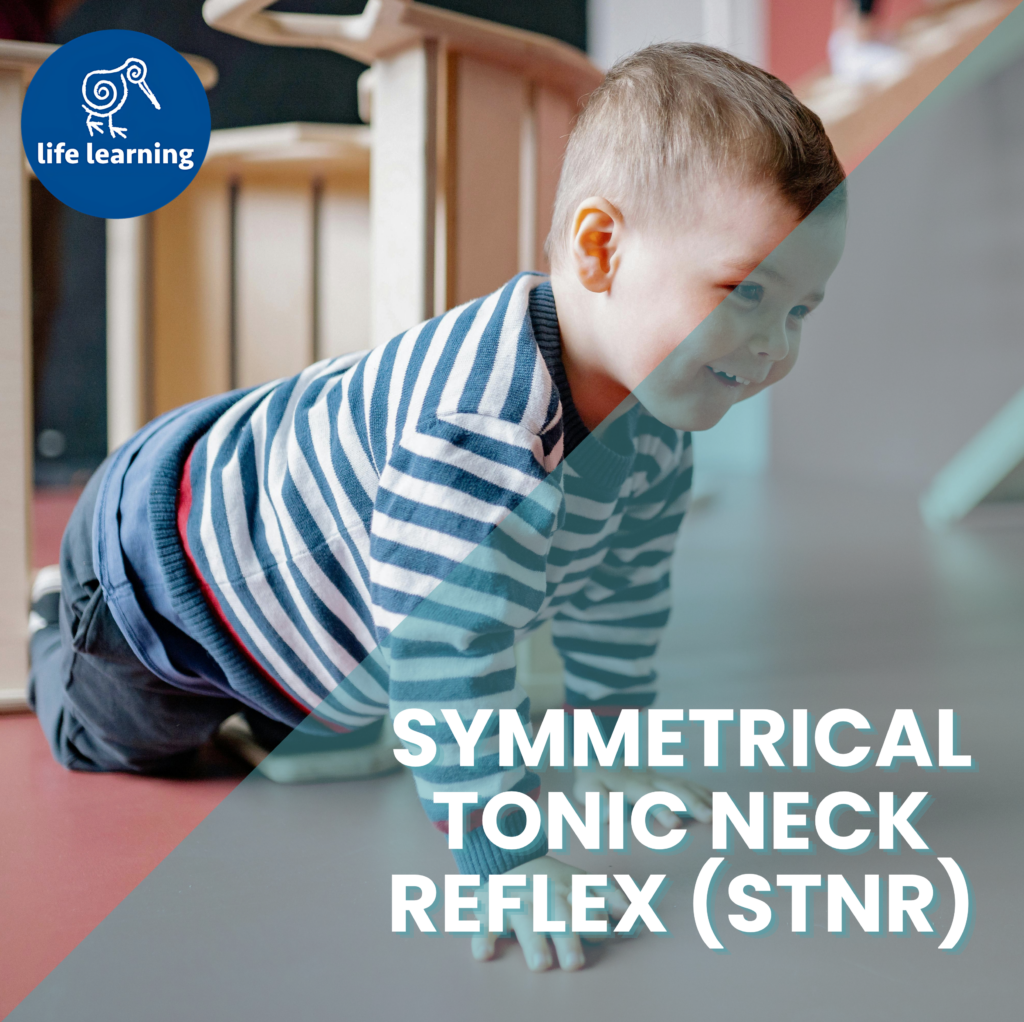
The symmetrical tonic neck reflex (STNR) is a primitive reflex that appears in the second half of a baby’s first year and helps prepare them for crawling. This guide explains what the reflex looks like, when it normally fades, and what current research does and doesn’t tell us about it.
What is the symmetrical tonic neck reflex?
The STNR links the movement of a baby’s head to the movement of their arms and legs. When the head tilts down, the arms tend to bend and the legs straighten. When the head tilts back, the arms tend to straighten and the legs bend. The reflex is automatic, so babies don’t choose it.
When does the STNR appear and fade?
The STNR appears about six to nine months after birth and usually fades by around nine to eleven months (StatPearls). Other sources give slightly different ages, so treat these as a range. As the STNR appears, the earlier asymmetrical tonic neck reflex (ATNR) fades. You can read about that reflex in our guide to the asymmetrical tonic neck reflex.
What does the STNR do in early development?
The STNR is thought to help babies get onto their hands and knees, which is why it’s sometimes called the “crawling reflex”. It also helps babies begin to use the top and bottom halves of their body separately, which supports early posture and eye-hand coordination (Healthline).
What if the STNR stays active in older children?
Some practitioners observe that when the STNR remains active beyond infancy, children may find it harder with sitting posture, copying from a board, ball skills or sitting still.
The research is still developing, so it’s worth being clear about what it shows. Studies have found associations between retained primitive reflexes and motor skills, but most of the evidence is observational and can’t show cause and effect. A review of studies on children without neurological conditions concluded that the evidence is not yet strong enough to link persistent reflexes to learning or behaviour difficulties (review).
So the STNR is one possible piece of a child’s developmental picture, never the whole explanation. Posture, attention and coordination challenges can have many causes.
What parents and educators may notice
Practitioners sometimes link the following observations with an active STNR. None of them confirms it, and none is a diagnosis:
- Slumping or propping the head on an arm when sitting or writing
- Difficulty sitting still at a desk or on the floor
- Trouble copying from a board
- Awkward ball skills or coordination
- Sitting in a “W” position
Playful movement ideas
Varied movement play is good for every child. Tummy time, crawling, rocking on hands and knees, animal walks and climbing all give children rich movement experiences. For more ideas, see the resources on the Life Learning Academy resources page.
When to seek advice
If you’re concerned about a child’s development, talk to a GP, paediatrician, occupational therapist or another qualified professional. This guide shares general educational information and is not a diagnosis or a substitute for individual advice.
Frequently Asked Questions
At what age does the STNR go away?
It usually fades between about nine and eleven months of age, although sources vary slightly.
Why is the STNR called the crawling reflex?
It helps babies move onto their hands and knees and start using the top and bottom halves of the body separately, which is part of the movement foundation for crawling.
Does a retained STNR affect learning?
No clear cause-and-effect link has been shown. Some studies find associations between retained reflexes and motor skills, but the research is limited, so we treat the STNR as one factor among many.
Learn more about the STNR with Life Learning Academy
If you’d like to explore the STNR in depth, our online course explains the reflex, how to observe it and practical movement activities. It includes testing guidance, an exercise toolbox, music and movement resources, downloadable activity cards and a support plan template.